Loading...
Battle of Gettysburg
July 1, 1863Gettysburg, Pennsylvaniahigh importance
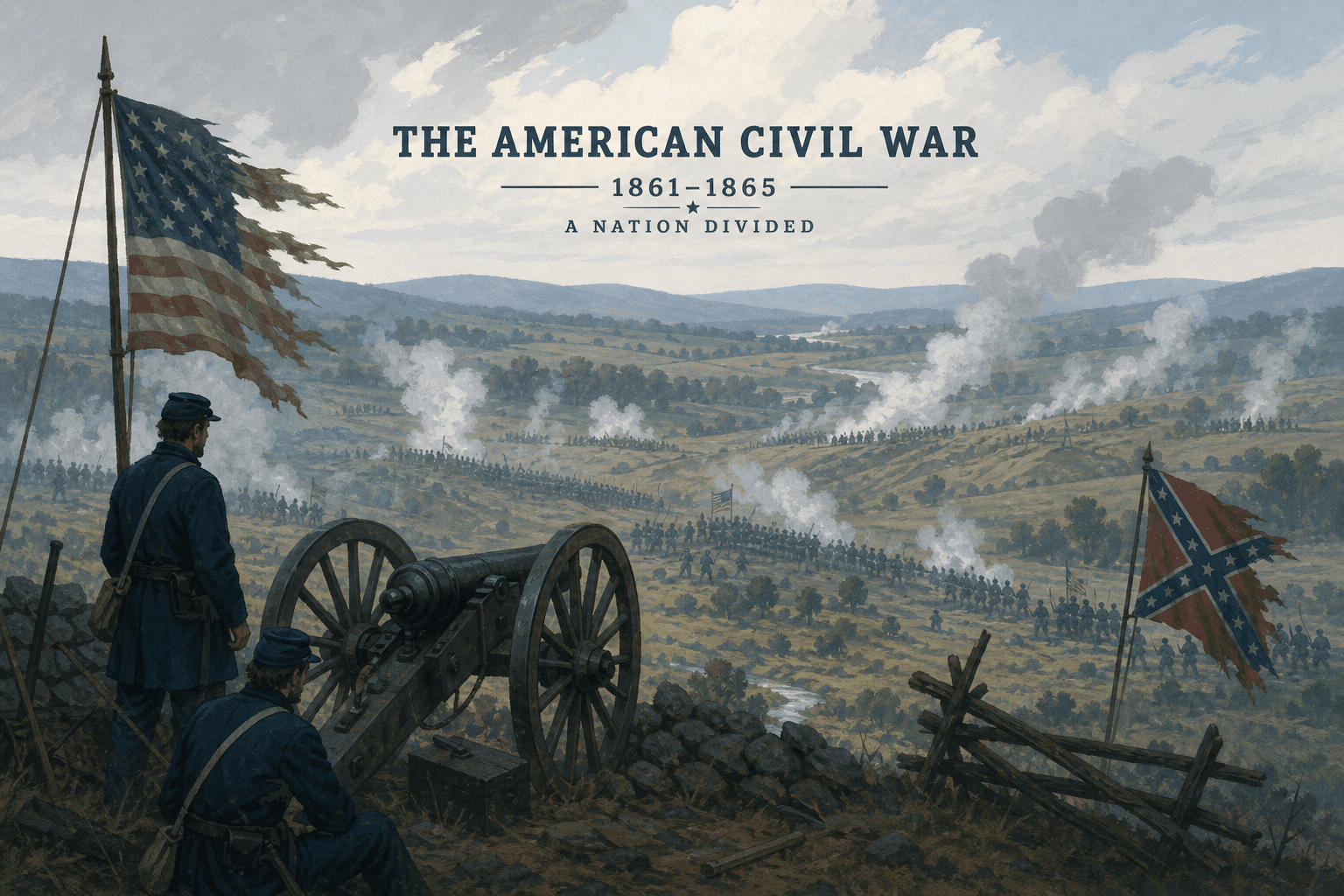
The bloodiest battle of the Civil War and a turning point for the Union.
Where this fits on the timeline. In the spring of 1863, Robert E. Lee won a brilliant but costly victory at Chancellorsville and decided to carry the war onto Northern soil for a second time. The three-day Battle of Gettysburg (July 1-3, 1863) ended that invasion, and it came the very same days that Vicksburg was falling in the West. Together the two Union victories mark the great turning point of the Civil War.
The road to Gettysburg
Lee gambled on invading the North. After Chancellorsville, Lee led the Army of Northern Virginia north through Maryland and into Pennsylvania, hoping to gather supplies, relieve war-torn Virginia, and win a victory on Union soil that might weaken Northern support for the war or bring foreign recognition of the Confederacy. President Lincoln placed General George G. Meade in command of the Army of the Potomac only three days before the battle. Neither commander planned to fight at Gettysburg; the armies collided there almost by accident when Confederate troops looking for supplies ran into Union cavalry.
Day one: collision at Gettysburg
The armies met west and north of town. On July 1, fighting erupted as Confederate forces pushed toward the crossroads town. Union cavalry under John Buford and then the infantry fought stubbornly but were outnumbered and driven back through the streets of Gettysburg. They rallied on the high ground south of town, digging in along Cemetery Hill and Culp's Hill, the strong defensive line that would shape the next two days.
Day two: the flanks and Little Round Top
Lee attacked both ends of the Union line. On July 2, Confederate assaults hammered the Union positions in some of the war's most famous fighting, at Little Round Top, Devil's Den, the Wheatfield, and the Peach Orchard. On Little Round Top, a Maine regiment under Colonel Joshua Chamberlain held the far left of the Union line against repeated charges, running low on ammunition before ordering a bayonet counterattack. Despite fierce pressure, the Union line bent but did not break.
Day three: Pickett's Charge
Lee staked everything on a frontal assault. On July 3, after a massive artillery bombardment, Lee sent roughly 12,500 men across three-quarters of a mile of open field toward the Union center on Cemetery Ridge. Known as Pickett's Charge, the attack met devastating artillery and rifle fire. A small group briefly pierced the Union line at a spot later called the High Water Mark of the Confederacy, but the charge was thrown back with terrible losses. Lee's invasion was broken.
The staggering cost
Gettysburg was the bloodiest battle ever fought in North America. Over three days, an estimated 51,000 soldiers on both sides were killed, wounded, captured, or missing, roughly 23,000 Union and 28,000 Confederate. Whole regiments were destroyed, and the small town was left to care for thousands of wounded and to bury the dead. These figures are estimates, and behind each number was a soldier, a family, and a community changed forever. Lee retreated to Virginia on July 4, and the Confederacy never again mounted a major invasion of the North.
The turning point and the Gettysburg Address
Two victories in one week turned the war. As Gettysburg ended, Vicksburg surrendered on July 4, 1863, giving the Union control of the full length of the Mississippi River. Together the victories shifted the momentum of the war toward the Union. That November, on November 19, 1863, Lincoln traveled to Pennsylvania to help dedicate the new soldiers' cemetery. The famous orator Edward Everett spoke for two hours; Lincoln then spoke for about two minutes. In roughly 272 words, his Gettysburg Address opened with 'four score and seven years ago' and redefined the war around the promise that 'all men are created equal,' calling for 'a new birth of freedom' and a government 'of the people, by the people, for the people.' You can follow the whole conflict in the American Civil War journey.
Related on StudyQuest
Further reading
Recommended, age-appropriate books to explore this further. Links open a library catalog search.
The Gettysburg Address
by Abraham Lincoln, illustrated by Michael McCurdy
Lincoln's speech in a striking illustrated edition.
The Long Road to Gettysburg
by Jim Murphy
The battle told through the diaries of two young soldiers; for students.
Fields of Fury: The American Civil War
by James M. McPherson
A leading historian's illustrated Civil War overview for young readers.
Key Takeaways
1
Fought July 1-3, 1863; the bloodiest battle ever on North American soil
2
Ended Lee's second and most ambitious invasion of the North
3
Roughly 51,000 total casualties over three days, both sides (estimates)
4
Pickett's Charge on July 3 failed at the 'High Water Mark of the Confederacy'
5
Paired with the fall of Vicksburg (July 4) as the war's great turning point
6
Lincoln's Gettysburg Address (Nov 19, 1863) reframed the war around freedom and democracy
Key Figures
Related Videos

A digital reimagining of Gettysburg - Anne Knowles
TED-Ed · 9:04
The Gettysburg Address Explained
Hip Hughes History · 6:42