Loading...
Emancipation Proclamation
January 1, 1863Washington, D.C.high importance
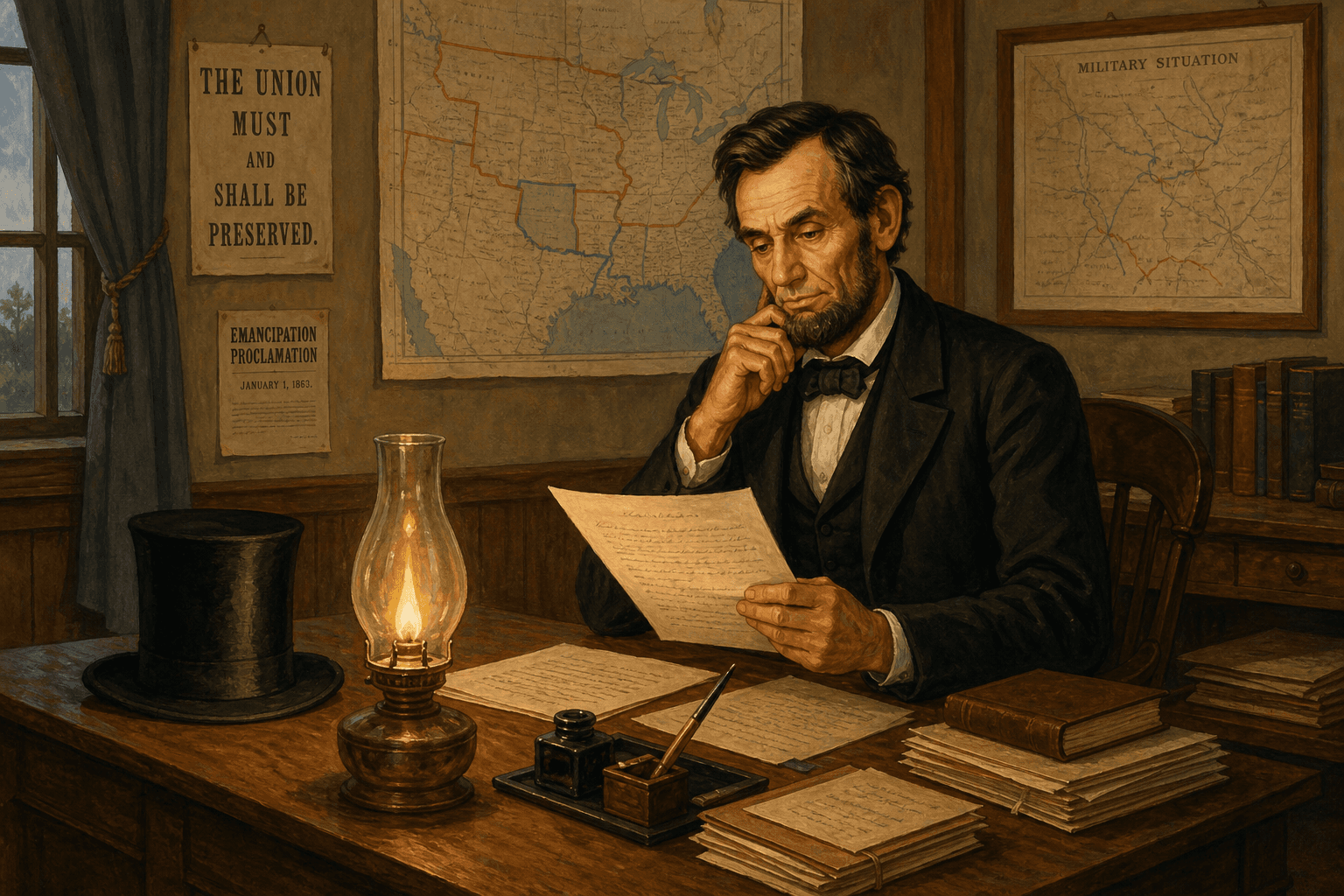
On January 1, 1863, Lincoln declared enslaved people in Confederate-held areas free, reshaping the war as a fight for Union and human freedom.
Where this fits on the timeline. For the first year and a half of the Civil War, the Union fought to restore the Union, not to end slavery. Abraham Lincoln changed that on January 1, 1863. The Emancipation Proclamation declared that all people held as slaves in the states still in rebellion were, and would forever be, free. It did not end slavery everywhere, but it turned the Union army into an army of liberation and made a return to the old Union impossible.
Why Lincoln waited
Law, politics, and the border states. Lincoln hated slavery, but as president he believed the Constitution gave him no power to abolish it in peacetime. He also needed the loyal slave states, Kentucky, Maryland, Missouri, and Delaware, to stay in the Union; freeing their slaves might push them out. Meanwhile enslaved people were deciding the question themselves, escaping to Union lines by the thousands, and abolitionists such as Frederick Douglass hammered Lincoln to make the war mean something. By July 1862 Lincoln had written a proclamation as a war measure, using his power as commander in chief to strike at the enemy's labor force. His cabinet persuaded him to wait for a victory, which came at Antietam in September.
What it said, and what it did not
Free in the places the Union did not control, and not free in the places it did. The final proclamation applied only to states and parts of states in rebellion. It exempted the border states and Union-occupied areas such as Tennessee and parts of Louisiana and Virginia, because there Lincoln's war powers did not apply. Critics then and since have noted that on the day it was signed it freed almost no one immediately. But it meant that wherever the Union army advanced, slavery ended, and roughly three and a half million people were promised freedom by the government that was fighting to reach them. It also invited Black men to join the army and navy. By the end of the war nearly 200,000 had served, about a tenth of the Union army, and their courage at places like Fort Wagner and Port Hudson helped change white Northerners' minds.
How it changed the war
A war for Union became a war for freedom. The proclamation ruled out any compromise peace that kept slavery, and it closed the door on European intervention: Britain, which had abolished slavery in its own empire, could not now side with the Confederacy. Douglass called it the first step toward a nation worthy of the name. Harriet Tubman went on to scout and spy for the Union army in South Carolina, guiding a raid that freed more than 700 people in a single night. Lincoln, who had once said he would save the Union without freeing any slave if he could, now told a friend that if his name ever went into history it would be for this act.
Finishing the job
Freedom in the border states took an amendment. Because the proclamation rested on war powers, Lincoln feared the courts might undo it once the fighting stopped. He pushed Congress to pass the Thirteenth Amendment, which abolished slavery everywhere in the United States; the House passed it in January 1865 and the states ratified it that December. The last enslaved people in Texas learned of their freedom on June 19, 1865, the date now kept as Juneteenth. Read the document at the National Archives, then follow the war to Gettysburg and Appomattox.
Further reading
Start with the text itself. The National Archives has the original with a transcript, and the American Battlefield Trust explains the war-powers argument. Eric Foner's The Fiery Trial traces how Lincoln's thinking about slavery changed, and Douglass's own Narrative shows what was at stake.
Related on StudyQuest
Learn more
- National Archives: Featured Document (primary source)
- Library of Congress: Emancipation Proclamation (primary source image)
- National Archives: DocsTeach activity
- Library of Congress: Frederick Douglass Papers
- National Park Service: Frederick Douglass National Historic Site
- Learn more: Emancipation Proclamation (American Battlefield Trust)
Further reading
Recommended, age-appropriate books to explore this further. Links open a library catalog search.
The Fiery Trial: Abraham Lincoln and American Slavery
by Eric Foner
How Lincoln's views on slavery changed over his life, up to the Thirteenth Amendment; for grades 11 and 12.
Frederick Douglass: The Lion Who Wrote History
by Walter Dean Myers
The abolitionist who pushed Lincoln toward this document; for grades 5 to 8.
Key Takeaways
1
Changed the war into a fight against slavery
2
Allowed Black men to serve in the Union Army
3
Led to the 13th Amendment abolishing slavery