Loading...
Siege and Fall of Vicksburg
July 4, 1863Vicksburg, Mississippihigh importance
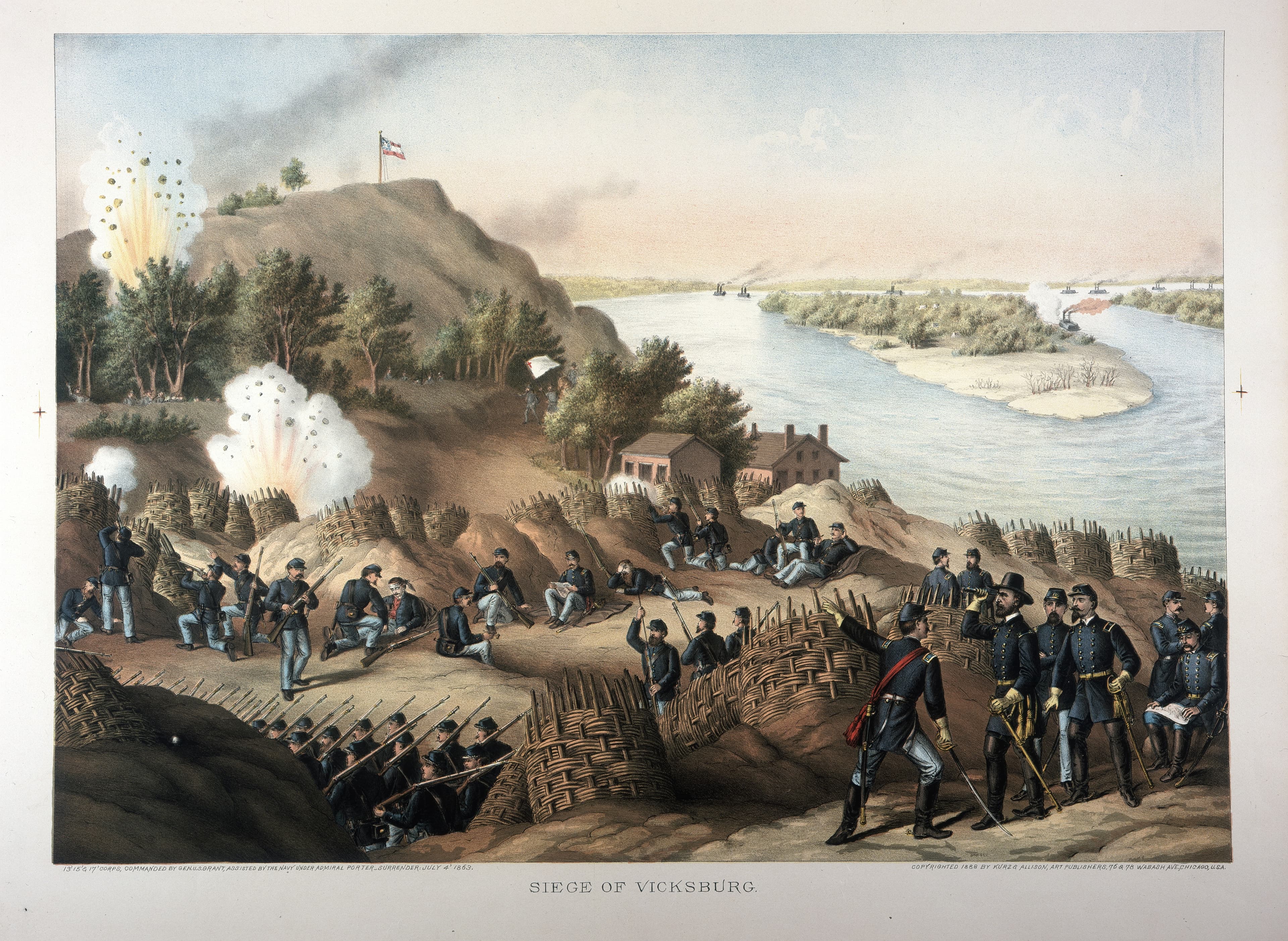
Union forces under Grant captured Vicksburg, Mississippi, splitting the Confederacy and opening the full length of the Mississippi River.
Where this fits on the timeline. While Lee marched toward Gettysburg in the summer of 1863, a quieter campaign in the West was deciding the war. Vicksburg, Mississippi, sat on a high bluff above a bend in the Mississippi River, the last Confederate stronghold on the river and the link between the eastern Confederacy and Texas, Arkansas, and Louisiana. Ulysses S. Grant took it on July 4, 1863, the day after Gettysburg ended, giving the Union the whole river and cutting the Confederacy in two. Lincoln called it the key.
Getting at the fortress
Grant tried everything, then did the unthinkable. Vicksburg's guns could not be approached from the river, and swamps and bayous blocked the land side to the north. Through the winter of 1862 to 1863 Grant dug canals and floated gunboats through flooded forests, and every attempt failed. In April he sent Admiral David Porter's gunboats racing past the batteries at night, marched his army down the Louisiana shore, and crossed the river below the city on April 30. Then he cut loose from his supply line, something his own generals thought reckless, and lived off the countryside.
Seventeen days
Five battles, then the trap closed. Moving fast, Grant's army won at Port Gibson, Raymond, Jackson, Champion Hill, and the Big Black River in seventeen days, scattering the Confederate forces that might have combined against him and driving John C. Pemberton's army back into the Vicksburg defenses. Two direct assaults on May 19 and 22 were bloodily repulsed, so Grant settled in to starve the city out. Union troops dug their trenches closer every night, artillery and gunboats shelled the town day and night, and residents moved into caves dug into the hillsides. By late June the garrison and civilians were eating mule meat, and a soldier's anonymous letter warned Pemberton that his men would mutiny if they were not fed.
The surrender
Independence Day, 1863. Pemberton, hoping for better terms on the national holiday, surrendered on July 4. Grant paroled the roughly 29,000 Confederate soldiers instead of sending them to prison camps, since feeding and shipping them north would have tied up his whole army. Port Hudson, the last Confederate post on the river, gave up five days later. Lincoln wrote that the Father of Waters again went unvexed to the sea. Grant, who had begun the war as a failed former officer clerking in his father's store, became the Union's indispensable general, and in March 1864 Lincoln put him in command of all the Union armies. Vicksburg, for its part, did not celebrate the Fourth of July again for decades.
Why it mattered as much as Gettysburg
Gettysburg stopped an invasion; Vicksburg took territory the South could never get back. Texas cattle, Louisiana sugar, and Arkansas grain could no longer reach the eastern armies, and Union gunboats now patrolled the river from Minnesota to the Gulf. Together the two July victories ended any real chance that Britain would recognize the Confederacy, and they set up the campaigns that finished the war: Grant's move east against Lee and William T. Sherman's march through Georgia. Follow the rest of the story in the Civil War journey.
Further reading
The siege lines survive. Vicksburg National Military Park preserves the trenches, the caves, and the raised gunboat Cairo, with campaign background on its history pages. The American Battlefield Trust has maps and primary sources. Donald L. Miller's Vicksburg is the fullest modern account.
Related on StudyQuest
Learn more
- National Park Service: Vicksburg
- Learn more: 10 Facts: Vicksburg Campaign (American Battlefield Trust)
- Learn more: Vicksburg Campaign, Unvexing Father Waters (American Battlefield Trust)
- Primary source: Our fate seems to stare us in the face (American Battlefield Trust)
- Learn more: Battle of Vicksburg (American Battlefield Trust)
Additional references
Further reading
Recommended, age-appropriate books to explore this further. Links open a library catalog search.
Key Takeaways
1
Union control of the Mississippi split the Confederacy
2
Grant’s persistence and siege tactics won a major Western victory
3
Fell the same week as Gettysburg, a double turning point in July 1863
4
Lincoln called Vicksburg the key to controlling the Mississippi River
Key Figures
Related Videos
The Civil War Animated Map
American Battlefield Trust · 27:28