Definition and inverse
How to do it:
1. Rewrite as
2. Cancel: and (for
3. Graph and as reflections across
Worked example: because See logarithm definition.
Check: on a calculator is base 10, so 2. is base
Loading...
Loading journey…
Relate exponents and logarithms, use log properties, and solve exponential equations. Aligned to HSF-LE.A.4 and HSF-BF inverses.
Aligned to HSF-LE.A.4, HSF-BF.B.4, HSF-BF.B.3, HSN-RN.A.2
 Share to Google Classroom (opens in a new tab)
For parents & teachers
A research-backed week of short routines that help a student study less and remember more: spacing, self-quizzing, and a calmer week before tests.
Discover
Think about this
Why must the argument of a real logarithm be positive?
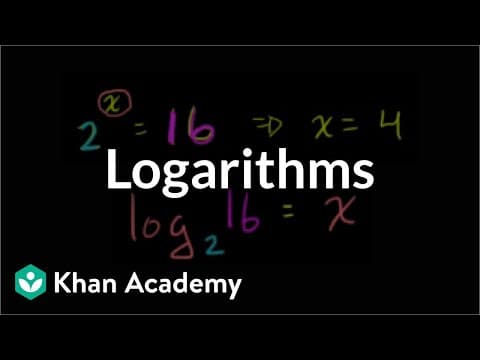
Logarithms | Logarithms | Algebra II | Khan Academy (7:02)
Learn
Read each section like a formula card: why it matters, the steps, one worked example, then the check. Try the steps yourself before moving to Practice.
How to do it:
1. Rewrite as
2. Cancel: and (for
3. Graph and as reflections across
Worked example: because See logarithm definition.
Check: on a calculator is base 10, so 2. is base
How to do it:
1. Products become sums:
2. Quotients become differences:
3. Exponents come out front:
4. Change of base: so a calculator can evaluate any base.
Worked example: Replay product rule.
Check: is not The argument of a real log must stay positive.
How to do it:
1. Isolate the exponential.
2. Take log of both sides (any matching base, or
3. Use then divide to get
Worked example: Divide: so If the number is not a nice power,
Check: plug back into the original. Exponent properties for rationals ( live in rational exponent as a radical.
How to do it:
1. In is the starting amount and is the growth factor per step.
2. Growth by percent means decay by percent means Half-life means per half-life.
3. Count the steps carefully: is measured in the same unit the factor uses.
Worked example: at per year for years: dollars. An -gram sample with a half-life of days, after days: that is half-lives, so grams.
Check: grows and decays. A common slip is writing for growth; the factor is because you keep the whole and add the interest.
How to do it:
1. Read as the denominator is the root, the numerator is the power.
2. Take the root first when you can; it keeps the numbers small.
3. A negative exponent means reciprocal, not a negative answer:
Worked example:
Check: the exponent rules still hold: and agrees. Replay rational exponent as a radical.
How to do it:
1. Isolate the exponential: divide by
2. Take (or of both sides and bring the exponent down:
3. Divide, evaluate, and say what the number means in the story.
Worked example: when does growing per year reach so and About years.
Check: If the money had only doubled ( years) it would be so about years for five times is reasonable.
How to do it:
1. When growth compounds continuously (every instant), the model is is the start, the rate as a decimal, the time.
2. is just a number, so is evaluated on a calculator like any other power.
3. To solve for take of both sides; undoes so
Worked example: at for years. Continuous: Compounded once a year instead: a little less, because it compounds less often. Doubling time: so and years.
Check: and the rule of says doubling takes about years, so is right. More frequent compounding always gives a slightly larger amount, never a smaller one.
How to do it:
1. shifts up the horizontal asymptote moves to
2. shifts right (the sign inside works backwards). reflects across the -axis; stretches by
3. The same rules move there the vertical asymptote shifts with
Worked example: stretch by shift down Asymptote -intercept so shifts the log right with asymptote and domain
Check: the horizontal shift is the opposite of the sign you see: moves right. Test the intercept by substituting
How to do it:
1. Swap and
2. Isolate the exponential, then rewrite it as a log to free
3. Check a point: if is on the original, must be on the inverse.
Worked example: Swap: Divide: Rewrite: The point on the original becomes
Check: the inverse of a growth function takes an amount and returns the time, which is exactly what solving for did above. Domains swap too: the inverse only accepts
Practice
Apply what you read with the activities below. Use calculators and formula sheets as needed; scored quizzes are in Apply.
8 questions picked from what you need most
15 cards
1 matching · 1 fill-in
Your place saves as you go. Use Back to journey when you are ready to continue the path.
Apply
The best check is explaining Algebra II: Exponentials & Logarithms in your own words. The tutor listens like a curious friend and asks clarifying questions. No score, no grade.
Explain Algebra II: Exponentials & Logarithms as if to someone who has never heard of it. The tutor responds like a curious learner with clarifying questions, not a score.
Want a scored check? Open it here. The teach-back above does not require finishing it.
The scored check opens up once you have spent a little time in Learn and Practice. Recall sticks best after you have engaged with the material first.