Measure angles in radians, extend sine and cosine to the unit circle, use the Pythagorean identity, and choose a sine or cosine model for a periodic story. Aligned to HSF-TF. Fills the Pre-Calculus subject shelf.
What you’ll learn
Reference angles carry first-quadrant values to every quadrant; attach the sign for the quadrant.
Arc length s=rθ and sector area A=21r2θ need radians; to solve cosθ=21, find the reference angle and place it in each quadrant where the sign fits.
Radians measure arc length on the unit circle.
(cos θ, sin θ) is the point at angle θ.
sin²θ + cos²θ = 1 always.
Periodic models need amplitude, period, and midline.
Aligned to HSF-TF.A.1, HSF-TF.A.2, HSF-TF.A.3, HSF-TF.B.5, HSF-TF.B.7, HSF-TF.C.8
A research-backed week of short routines that help a student study less and remember more: spacing, self-quizzing, and a calmer week before tests.
Learning acts
Discover
Think about this
Why can many different θ values share the same sine?
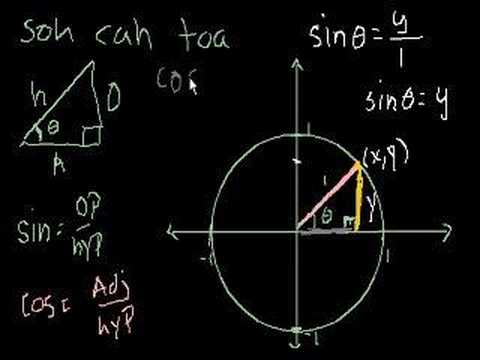
A point at angle θ (radians counterclockwise from the positive x-axis) is (cos θ, sin θ).
Unit Circle Definition of Trig Functions (10:13)
Learn
Read each section like a formula card: why it matters, the steps, one worked example, then the check. Try the steps yourself before moving to Practice.
Radians
How to do it:
1. One radian is the angle that cuts an arc equal to the radius.
2. Convert: θrad=θdeg⋅π/180. A full turn is 2π radians (360°).
3. Arc length: θ=s/r, so s=rθ with θ in radians.
Worked example:180°=π radians. 90°=2π.30°=6π.
Check: do not treat "2π" as about 2. It is about 6.28 radians. Calculators in degree mode will misread π/2.
Unit circle coordinates
How to do it:
1. Start at (1,0) on the unit circle and walk counterclockwise for positive θ.
2. The point is (cosθ,sinθ). Negative θ goes clockwise.
3. Coterminal angles differ by 2π; they land on the same point.
Worked example:cos(π)=−1,sin(π)=0.cos(2π)=0,sin(2π)=1.
A point at angle θ (radians counterclockwise from the positive x-axis) is (cos θ, sin θ).
Check: Quadrant II sine is positive, cosine negative, matching Grade 6 sign work on the plane.
Pythagorean identity
How to do it:
1. A point (cosθ,sinθ) is 1 unit from the origin, so sin2θ+cos2θ=1.
2. If you know one coordinate and the quadrant, solve for the other. See Pythagorean identity.
3. Keep the sign that matches the quadrant.
Worked example: If sinθ=3/5 in Quadrant I, cosθ=4/5 because (3/5)2+(4/5)2=1.
Check: Quadrant II would take cosθ=−4/5. Squaring loses the sign, so you must put it back.
Periodic models
How to do it:
1. Midline D is the average of max and min.
2. Amplitude A is half the range (always positive).
3. Period T is the time for one cycle; B=2π/T in y=Asin(B(t−C))+D.
Worked example: A tide with midline 4 ft, amplitude 2 ft, period 12 hours: B=2π/12=π/6, so y=2sin(6πt)+4 if you start at the midline going up.
Check: period of sin(2t) is π, not 2. If t=0 is a max, cosine is often cleaner than sine.
Exact values and reference angles
How to do it:
1. Learn the first-quadrant values: for 6π,4π,3π, sine is 21,22,23, and cosine runs the same list backwards.
2. For any angle, find its reference angle: the acute angle between the terminal side and the x-axis.
3. Copy the first-quadrant value and attach the sign for the quadrant: sine is positive in I and II, cosine in I and IV.
Worked example:cos(65π): reference angle 6π, quadrant II, cosine negative, so −23.sin(47π): reference 4π, quadrant IV, sine negative: −22.sin(34π): reference 3π, quadrant III: −23.
Check: the pair must satisfy the identity: (−23)2+(21)2=1. "All Students Take Calculus" lists which functions are positive in quadrants I through IV: all, sine, tangent, cosine.
Tangent on the unit circle
How to do it:
1. tanθ=cosθsinθ=xy, the slope of the terminal ray.
2. It is undefined where cosθ=0, at 2π and 23π: the graph has vertical asymptotes there.
3. Its period is π, not 2π, because a slope repeats every half turn.
Worked example:tan(4π)=1, the slope of the 45° line. tan(32π)=−1/23/2=−3.tan(π)=−10=0.tan(45π)=1 again, a half turn after 4π.
Check: tangent is positive in quadrants I and III, where x and y share a sign. The reciprocals are secθ=cosθ1,cscθ=sinθ1, and cotθ=tanθ1.
Arc length and sector area
How to do it:
1. With θ in radians, arc length is s=rθ.
2. Sector area is A=21r2θ.
3. If the angle is given in degrees, convert first: multiply by 180π. The formulas only work in radians.
Worked example:r=10 cm and θ=32π:s=10⋅32π≈20.9 cm and A=21⋅100⋅32π≈104.7 cm2. A 60° slice of a 12-inch pizza (r=6):θ=3π, so the area is 21⋅36⋅3π=6π≈18.8 in2.
Check: a full turn (θ=2π) gives s=2πr and A=πr2, the circle formulas you already know. Replay arc length and sector area.
Read a graph from its equation
How to do it:
1. In y=Asin(B(x−C))+D or the cosine version, ∣A∣ is the amplitude, B2π the period, C the horizontal shift, and D the midline.
2. The maximum is D+∣A∣ and the minimum is D−∣A∣.
3. Sketch one period from the starting point using five key points: start, quarter, half, three-quarter, end.
Worked example:y=3cos(2x)−1: amplitude 3, period π, midline y=−1, so the maximum 2 is at x=0, the minimum −4 at x=2π, and the next maximum at x=π.y=2sin(x−3π) is a sine wave of amplitude 2 shifted right 3π.
Check: factor before reading a shift: sin(2x−π)=sin(2(x−2π)), so the shift is 2π, not π. A negative A flips the graph across the midline.
Solve a basic trig equation
How to do it:
1. Isolate the trig function.
2. Find the reference angle from the exact-value table or an inverse function.
3. Place it in every quadrant where the sign is right, inside the interval asked. For all solutions, add 2πk.
Worked example:2cosθ−1=0 on [0,2π):cosθ=21, reference angle 3π, cosine positive in I and IV, so θ=3π or 35π. For the tide y=2sin(6πt)+4, when is y=5 in the first 12 hours? sin(6πt)=21, so 6πt=6π or 65π:t=1 hour and t=5 hours.
Check: substitute back: 2cos(35π)−1=2⋅21−1=0. A calculator's cos−1 returns only 3π; the quadrant reasoning supplies the second answer.
Key points to remember
Reference angles carry first-quadrant values to every quadrant; attach the sign for the quadrant.
Arc length s=rθ and sector area A=21r2θ need radians; to solve cosθ=21, find the reference angle and place it in each quadrant where the sign fits.
Radians measure arc length on the unit circle.
(cos θ, sin θ) is the point at angle θ.
sin²θ + cos²θ = 1 always.
Periodic models need amplitude, period, and midline.
Practice
Practice what you learned
Apply what you read with the activities below. Use calculators and formula sheets as needed; scored quizzes are in Apply.
Your place saves as you go. Use Back to journey when you are ready to continue the path.
Apply
Apply what you learned
The best check is explaining Pre-Calculus: Unit Circle & Periodic Models in your own words. The tutor listens like a curious friend and asks clarifying questions. No score, no grade.
Explain it in your own words
Explain Pre-Calculus: Unit Circle & Periodic Models as if to someone who has never heard of it. The tutor responds like a curious learner with clarifying questions, not a score.
+Reflection prompts (optional)
Why can many different θ values share the same sine?
How is a radian a ratio of lengths, not a second kind of degree?
When would you choose cosine instead of sine for a Ferris-wheel height?
+Optional: scored check
Want a scored check? Open it here. The teach-back above does not require finishing it.
The scored check opens up once you have spent a little time in Learn and Practice. Recall sticks best after you have engaged with the material first.