Add, multiply, and factor polynomials, read zeros from a factorization, and compute with complex numbers a + bi. Aligned to HSA-APR and HSN-CN.
What you’ll learn
The remainder on dividing p(x) by (x−a) is p(a); remainder 0 means (x−a) is a factor.
Powers of i cycle every four (i,−1,−i,1), conjugates multiply to the real number a2+b2, and a negative discriminant gives a conjugate pair of complex solutions.
Polynomials add and multiply like integers; division is a later remainder story.
Factored form shows zeros and multiplicity.
i is defined by i² = −1; every complex number is a + bi.
Aligned to HSA-APR.A.1, HSA-APR.B.3, HSN-CN.A.1, HSN-CN.A.2, HSN-RN.A.2
A research-backed week of short routines that help a student study less and remember more: spacing, self-quizzing, and a calmer week before tests.
Learning acts
Discover
Think about this
Why is there no order “greater than” for complex numbers the way there is for reals?
(2 + 3i)(1 − i) = 5 + i. Real part is the x-coordinate; imaginary part is the y-coordinate.
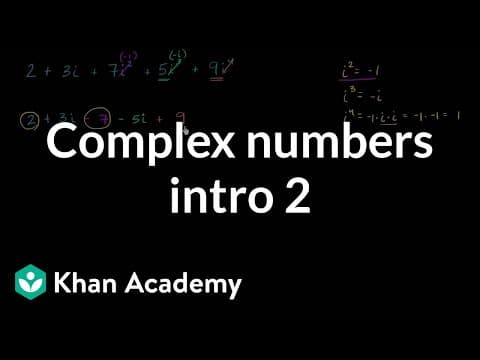
Introduction to complex numbers | Imaginary and complex numbers | Algebra II | Khan Academy (4:39)
Learn
Read each section like a formula card: why it matters, the steps, one worked example, then the check. Try the steps yourself before moving to Practice.
Polynomial arithmetic
How to do it:
1. Add or subtract like terms (same variable, same exponent).
2. Multiply using distribution or an area model.
3. The degree of a product is the sum of the degrees.
2. Plot the zeros. Odd multiplicity crosses; even multiplicity bounces.
3. Use the leading term for end behavior as x→±∞.
Worked example:p(x)=(x+2)(x−1)2 has zeros −2 (simple, crosses) and 1 (double, bounce). Leading term x3, so as x→∞,p(x)→∞, and as x→−∞,p(x)→−∞.
p(x) = (x + 2)(x − 1)² crosses at −2 (odd multiplicity) and bounces at 1 (even).
Check: a double zero on the axis looks like it "touches and turns." Expanding to check: (x+2)(x2−2x+1)=x3−3x+2.
Complex numbers
How to do it:
1. Define i by i2=−1. Write z=a+bi.
2. Add real parts and imaginary parts separately.
3. Multiply with distribution, then replace i2 with −1.
Worked example:(2+3i)(1−i)=2−2i+3i−3i2=2+i+3=5+i.
(2 + 3i)(1 − i) = 5 + i. Real part is the x-coordinate; imaginary part is the y-coordinate.
Check:x2+1=0 → x=±i. The quadratic formula still works; a negative discriminant becomes bi. Plot 5+i as the point (5,1) on the plane.
Multiply bigger polynomials with a table
How to do it:
1. Write one factor across the top of a grid and the other down the side, one term per cell.
2. Multiply into every cell.
3. Add the cells and combine like terms; the degree of the product is the sum of the degrees.
Worked example:(x+2)(x2−3x+4). Row x:x3,−3x2,4x. Row 2:2x2,−6x,8. Add: x3−x2−2x+8.
Check: a degree-1 times a degree-2 polynomial has degree 3, and a quick test at x=1 works: (3)(2)=6 and 1−1−2+8=6.
Divide by a factor, and the remainder theorem
How to do it:
1. Divide as with long division: divide leading terms, multiply back, subtract, bring down, repeat.
2. Remainder theorem: dividing p(x) by (x−a) leaves remainder p(a), so you can find the remainder by substituting.
3. Remainder 0 means (x−a) is a factor and a is a zero (factor theorem).
Worked example:(x3−3x+2)÷(x−1).x3÷x=x2; subtract x2(x−1)=x3−x2 to get x2−3x; then +x leaves −2x+2; then −2 leaves 0. Quotient x2+x−2, remainder 0, so x−1 is a factor. For the remainder on dividing by (x−2), just substitute: p(2)=8−6+2=4.
Check:(x−1)(x2+x−2)=x3−3x+2. And p(1)=1−3+2=0 confirms the zero at 1.
Special products and the cube patterns
How to do it:
1. Difference of squares: a2−b2=(a−b)(a+b).
2. Perfect square trinomial: a2±2ab+b2=(a±b)2.
3. Sum and difference of cubes: a3+b3=(a+b)(a2−ab+b2) and a3−b3=(a−b)(a2+ab+b2). The sign in the binomial matches the original; the middle sign in the trinomial is opposite.
Worked example:4x2−25=(2x−5)(2x+5).x2+6x+9=(x+3)2.x3−8=x3−23=(x−2)(x2+2x+4).
Check: expand (x−2)(x2+2x+4)=x3+2x2+4x−2x2−4x−8=x3−8. The middle terms cancel in pairs, which is the whole point of the pattern.
Complex conjugates and division
How to do it:
1. The conjugate of a+bi is a−bi. Their product is real: (a+bi)(a−bi)=a2+b2.
2. To divide, multiply the top and bottom by the conjugate of the bottom.
3. Simplify with i2=−1 and write the answer as a+bi.
Worked example:1−i2+3i. Multiply by 1+i1+i: top (2+3i)(1+i)=2+2i+3i+3i2=−1+5i; bottom (1−i)(1+i)=1−i2=2. So 2−1+5i=−21+25i.
1. The powers cycle every four: i1=i,i2=−1,i3=−i,i4=1, then repeat.
2. For a big power, divide the exponent by 4 and use the remainder.
3. x2+k=0 with k>0 has the two solutions x=±ik; a quadratic with a negative discriminant has two complex solutions that are conjugates.
Worked example:i23:23=4(5)+3, so i23=i3=−i.x2+9=0:x2=−9, so x=±3i.x2−2x+5=0: the discriminant is 4−20=−16, so x=22±−16=22±4i=1±2i.
Check:(3i)2=9i2=−9, so x2+9=0 holds. The two solutions 1+2i and 1−2i are conjugates, as they must be when the coefficients are real.
Key points to remember
The remainder on dividing p(x) by (x−a) is p(a); remainder 0 means (x−a) is a factor.
Powers of i cycle every four (i,−1,−i,1), conjugates multiply to the real number a2+b2, and a negative discriminant gives a conjugate pair of complex solutions.
Polynomials add and multiply like integers; division is a later remainder story.
Factored form shows zeros and multiplicity.
i is defined by i² = −1; every complex number is a + bi.
Practice
Practice what you learned
Apply what you read with the activities below. Use calculators and formula sheets as needed; scored quizzes are in Apply.
Your place saves as you go. Use Back to journey when you are ready to continue the path.
Apply
Apply what you learned
The best check is explaining Algebra II: Polynomials & Complex Numbers in your own words. The tutor listens like a curious friend and asks clarifying questions. No score, no grade.
Explain it in your own words
Explain Algebra II: Polynomials & Complex Numbers as if to someone who has never heard of it. The tutor responds like a curious learner with clarifying questions, not a score.
+Reflection prompts (optional)
Why is there no order “greater than” for complex numbers the way there is for reals?
How does multiplicity change the graph at a zero?
Why is the product of two polynomials always a polynomial?
+Optional: scored check
Want a scored check? Open it here. The teach-back above does not require finishing it.
The scored check opens up once you have spent a little time in Learn and Practice. Recall sticks best after you have engaged with the material first.