The arithmetic every later Algebra I step depends on: add and subtract signed numbers as movement on a number line, use the counting rule for products and quotients, read absolute value as distance, and evaluate expressions with negatives, where −x² and (−x)² differ. Aligned to 7.NS, revisited at the start of Algebra I.
What you’ll learn
Before every problem, name the operation: add or subtract means movement on the number line (same signs add and keep, different signs subtract and take the larger sign); multiply or divide means count the negatives (even positive, odd negative).
Decide which rule set applies (add/subtract vs multiply/divide) before you touch the numbers.
Same signs add and keep the sign; different signs subtract and take the sign of the larger value.
Subtracting a negative is adding a positive.
An even count of negative factors gives a positive product or quotient; an odd count gives a negative one.
Absolute value is distance from zero, so it is never negative, and a sign outside the bars survives.
A research-backed week of short routines that help a student study less and remember more: spacing, self-quizzing, and a calmer week before tests.
Learning acts
Discover
Think about this
Why does "two negatives make a positive" hold for −42÷(−7) but fail for −42+(−17)?
|−54| and |54| both equal 54 because distance has no direction. A minus sign outside the bars survives: −|−54| = −54.
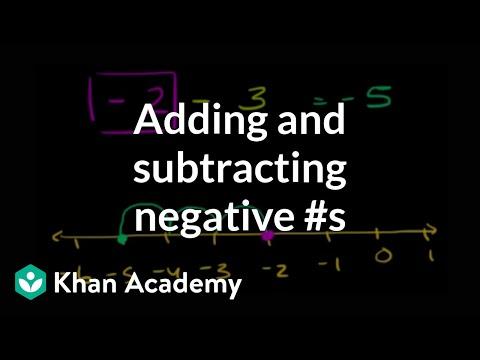
Adding and subtracting negative numbers (4:06)
Learn
Read each section like a formula card: why it matters, the steps, one worked example, then the check. Try the steps yourself before moving to Practice.
Add and subtract: movement on a number line
How to do it:
1. Check the signs. Same signs: add the values and keep that sign.
2. Different signs: subtract the smaller value from the larger and take the sign of the larger.
3. Rewrite any "minus a negative" as "plus a positive" first.
Worked example:−42+(−17)
1. Name the operation: addition, so use the number-line rules.
2. Compare the signs: both negative, so they match.
3. Add the values: 42+17=59.
4. Keep the shared sign: −42+(−17)=−59.
Now change one sign:−42+17
1. The signs differ, so subtract the smaller value from the larger: 42−17=25.
2. The larger value, 42, was negative, so the answer is −25.
Adding a negative walks further left. Subtracting a negative reverses that and walks right, which is why 8 − (−9) = 17.
Check: money is the reliable test. Owing $42 and borrowing $17 more leaves you owing $59. Owing $42 and paying back $17 still leaves you owing $25.
Subtracting a negative
How to do it:
1. Spot the two minus signs sitting next to each other.
2. Replace them with a plus: a−(−b)=a+b.
3. Add as usual.
Worked example:8−(−9)
1. Spot the two minus signs side by side.
2. Rewrite them as a plus: 8+9.
3. Add: 8+9=17.
Check: subtracting means taking away, and taking away a debt makes you richer. If someone cancels a $9 debt, you are $9 better off. On the number line, subtracting a negative moves you right instead of left.
Multiply and divide: count the negatives
How to do it:
1. Count how many negative factors the problem has.
2. Even count (0, 2, 4, ...) means the answer is positive; odd count (1, 3, 5, ...) means negative.
3. Decide the sign first, then multiply or divide the values and attach it.
Worked example:−2(−3)(−4)
1. Count the negatives: three.
2. Three is odd, so the answer is negative. Decide this before computing.
3. Multiply the values: 2⋅3⋅4=24.
4. Attach the sign: −24.
Division works the same way:−42÷(−7)
1. Count the negatives: two, an even count, so the answer is positive.
2. Divide the values: 42÷7=6, so the answer is 6.
Check: the classic trap is carrying "two negatives make a positive" into addition. It is false there: −42+(−17)=−59, while −42÷(−7)=6. Same-looking numbers, opposite signs, because the operations use different rules.
Absolute value is distance
How to do it:
1. Read ∣a∣ as "how far is a from 0", so the result is never negative.
2. Treat the bars as grouping symbols: simplify inside first.
3. Apply anything outside the bars only after the bars are gone.
Worked example:−∣−12∣
1. Simplify inside the bars first: ∣−12∣=12.
2. Apply the minus outside the bars: −12.
3. The two signs do not cancel; the bars erase only the sign inside.
Plain distance:∣54∣=54 and ∣−54∣=54, since both sit 54 units from zero.
|−54| and |54| both equal 54 because distance has no direction. A minus sign outside the bars survives: −|−54| = −54.
Check: a minus sign outside the bars always survives, so −∣−12∣ is negative. Each set of bars is its own container: ∣3∣−∣−1∣=3−1=2, not ∣3−(−1)∣=4.
Example bank: the same two numbers, every rule
How to do it:
1. Name the operation before you touch the numbers.
2. Adding or subtracting: use the number-line rules (same signs add and keep the sign; different signs subtract and take the larger sign).
3. Multiplying or dividing: count the negatives, then compute. Absolute value: simplify inside the bars first; anything outside waits.
Worked example: take −15 and 6, and run them through every rule. Read each row left to right: problem, rule, work, answer.
Problem
Rule that applies
Work
Answer
−15+6
Different signs: subtract, keep the larger value's sign
15−6=9
−9
−15−6
Subtracting a positive moves left
Start at −15, move 6 left
−21
−15−(−6)
Two minus signs together become a plus
−15+6
−9
(−15)(−6)
Two negatives: even count, so positive
15⋅6=90
90
−15÷6
One negative: odd count, so negative
15÷6=2.5
−2.5
∣−15∣−∣6∣
Each set of bars is its own container
15−6
9
−∣−15∣
Simplify inside first; the outside minus survives
∣−15∣=15
−15
Check:−15+6 and −15−(−6) give the same answer, −9, because subtracting a negative is adding a positive. And (−15)(−6) is positive while −15+(−6) is negative: same numbers, different operation, different rule.
Evaluate an expression: substitute with parentheses
Think of the letter as a parking spot. The number drives in and parks there, minus sign and all, and the parentheses are the lines that keep it together.
How to do it:
1. Substitute with parentheses. Every time you see the letter, write the number in its place inside parentheses, sign and all.
2. Grouping first. Work inside parentheses, under a fraction bar and inside absolute value bars before anything else.
3. Then the order of operations: exponents, then multiply and divide, then add and subtract.
Worked example: evaluate −x2+5x when x=−2.
1. Substitute with parentheses: −(−2)2+5(−2).
2. Exponent first: (−2)2=4, so the first part is −(4)=−4.
3. Multiply: 5(−2)=−10.
4. Combine: −4+(−10)=−14.
Square first, then apply the minus: −x² is never positive. Parentheses put the minus inside the square.
The big trap:−x2 means "the opposite of x squared." Square first, then apply the minus. When x=5,−x2=−(5)2=−25, but (−x)2=(−5)2=25. Written with numbers, −32=−9 while (−3)2=9: the parentheses decide whether the minus gets squared.
Grouping first: evaluate 9−(x+4)2 when x=−6.
1. Substitute: 9−((−6)+4)2.
2. Inside the parentheses first: (−6)+4=−2.
3. Exponent: (−2)2=4.
4. Subtract: 9−4=5.
When the bottom is zero: evaluate n−312 when n=3.
1. Work out the bottom first: (3)−3=0.
2. Now the problem is 12÷0. Division asks a multiplication question: what number times 0 gives 12? No number does, because anything times 0 is 0.
3. So the expression is undefined when n=3. (When n=−3 it is fine: −612=−2.)
Two letters and absolute value: evaluate ∣a+b∣−b2+a when a=4 and b=−7.
1. Substitute both letters: ∣(4)+(−7)∣−(−7)2+(4).
2. Inside the bars: 4+(−7)=−3, and ∣−3∣=3.
3. Exponent: (−7)2=49.
4. Put it together: 3−49+4=−42.
Worked example
Evaluate 2x2−x when x=−3.
1
Substitute −3 in parentheses everywhere you see x.
2(−3)2−(−3)
2
Exponent first: (−3)2=9.
2(9)−(−3)
3
Multiply, then rewrite minus a negative as plus.
18+3
4
Add.
21
Answer2x2−x=21
Now you try
Optional practice. This does not change your mastery result.
Step by stepProblem 1 of 4
Evaluate −x2−4x when x=−3.
1
Step 1 of 4.
Exponent first. What is (−3)2?
2
Step 2 of 4, locked.
Now apply the minus in front: −x2 is the opposite of x2. What is −(−3)2?
Opens after step 1
3
Step 3 of 4, locked.
Multiply the second part. What is −4(−3)?
Opens after step 1
4
Step 4 of 4, locked.
Combine the two parts.
Opens after step 1
Practice only. This does not change your mastery result.
Check: before you write the answer, find every number you substituted. Each one should still be inside parentheses. And remember that −x2 can never come out positive, whatever number x is.
Four ways signs go wrong
How to do it:
1. Reaching for the wrong rule: "two negatives make a positive" is a multiplication rule. In addition it is false: −42+(−17)=−59, not 59.
2. Dropping the second sign:8−(−9) is not 8−9. The parentheses are there for a reason: 8−(−9)=17.
3. Deciding the sign last: in −2(−3)(−4), count the negatives first (three, so negative), then multiply. Deciding afterward is where signs get lost.
4. Letting the bars erase too much: in −∣−7∣ the bars erase only the sign inside; the minus outside survives, so the answer is −7, not 7.
Worked example: a student writes −42+(−17)=59 because "two negatives make a positive."
1. Name the operation: addition, so the multiplication rule does not apply.
2. Use the number-line rule: same signs, so add the values, 42+17=59.
3. Keep the shared sign: the answer is −59, not 59.
4. Compare −42÷(−7)=6: that operation is division, so there the rule does apply.
Check: before every problem, name the operation out loud. Add or subtract means movement on a number line; multiply or divide means count the negatives.
Working with Negative Numbers
Algebra I · Reference sheet
Always ask this first: “Am I adding/subtracting, or multiplying/dividing?” The two use completely different sign rules. Decide the rule first, do the numbers second.
Rule Set 1 — Adding & Subtracting
think: MOVEMENT on a number line
If the signs are…
Do this
Answer’s sign
Example
The same
Add the values
Keep that shared sign
−42+(−17)=−59
Different
Subtract the smaller value from the larger
Sign of the bigger number
−42+17=−25
The double-negative rule: subtracting a negative is adding a positive, 8−(−9)→8+9=17. Taking away a debt makes you richer.
Rule Set 2 — Multiplying & Dividing
think: COUNT the negatives
How many negatives?
Answer’s sign
Example
Even (0, 2, 4…)
Positive
−42÷(−7)=6 (2 negatives)
Odd (1, 3, 5…)
Negative
−2(−3)(−4)=−24 (3 negatives)
Watch out —same numbers, different operation, opposite answer: −42+(−17)=−59 is negative, but −42÷(−7)=6 is positive. Two negatives make a positive only when multiplying or dividing — never when adding.
Absolute Value | n |
think: DISTANCE from zero — never negative
Inside the bars
Result
Positive
∣54∣=54 — unchanged
Negative
∣−54∣=54 — sign dropped
Zero
∣0∣=0
Bars work like parentheses. Simplify what’s inside first, before anything outside can touch it.
A minus sign outside the bars survives. The bars only erase what is inside, so −∣−12∣=−12. A minus outside the bars is never positive.
Each set of bars is its own container. Nothing crosses between them: ∣3∣−∣−1∣=3−1=2.
Watch out —in −∣−12∣ the two minus signs do not cancel. The inside one is deleted by the bars, so it never meets the outside one.
Key points to remember
Before every problem, name the operation: add or subtract means movement on the number line (same signs add and keep, different signs subtract and take the larger sign); multiply or divide means count the negatives (even positive, odd negative).
Decide which rule set applies (add/subtract vs multiply/divide) before you touch the numbers.
Same signs add and keep the sign; different signs subtract and take the sign of the larger value.
Subtracting a negative is adding a positive.
An even count of negative factors gives a positive product or quotient; an odd count gives a negative one.
Absolute value is distance from zero, so it is never negative, and a sign outside the bars survives.
Practice
Practice what you learned
Apply what you read with the activities below. Use calculators and formula sheets as needed; scored quizzes are in Apply.
Your place saves as you go. Use Back to journey when you are ready to continue the path.
Apply
Apply what you learned
The best check is explaining Algebra I: Signed Numbers & Absolute Value in your own words. The tutor listens like a curious friend and asks clarifying questions. No score, no grade.
Explain it in your own words
Explain Algebra I: Signed Numbers & Absolute Value as if to someone who has never heard of it. The tutor responds like a curious learner with clarifying questions, not a score.
+Reflection prompts (optional)
Before every problem, name the operation: add or subtract means movement on the number line (same signs add and keep, different signs subtract and take the larger sign); multiply or divide means count the negatives (even positive, odd negative).
Decide which rule set applies (add/subtract vs multiply/divide) before you touch the numbers.
Same signs add and keep the sign; different signs subtract and take the sign of the larger value.
Subtracting a negative is adding a positive.
An even count of negative factors gives a positive product or quotient; an odd count gives a negative one.
Discussion prompts
Why does "two negatives make a positive" hold for −42÷(−7) but fail for −42+(−17)?
How can you know the sign of −∣x∣ before you know anything about x?
+Optional: scored check
Want a scored check? Open it here. The teach-back above does not require finishing it.
The scored check opens up once you have spent a little time in Learn and Practice. Recall sticks best after you have engaged with the material first.