Loading...
D-Day (Normandy Invasion)
June 6, 1944Normandy, Francehigh importance
On June 6, 1944, about 156,000 Allied troops stormed the beaches of Normandy in the largest seaborne invasion in history, opening the fight to free Western Europe from Nazi rule.
Where this fits on the timeline. By the summer of 1944, World War II had raged for nearly five years. The United States had joined after Pearl Harbor in 1941, the Soviet Union was pushing the German army back from the east, and much of Western Europe was still under Nazi occupation. D-Day was the day the Allies came ashore in France to open a new front, the beginning of the end for Nazi Germany.
Why the Allies had to invade
To beat Germany, they had to get back into Europe. After the Nazis conquered France in 1940, there was no Allied army left on the European mainland in the west. The Soviet Union had been fighting and dying by the millions on the Eastern Front and pressed Britain and the United States to open a 'second front' to split Germany's forces. The plan was to land a huge army in Normandy, on the coast of northern France, and drive toward Germany. Standing in the way was the Atlantic Wall, a chain of bunkers, gun positions, mines, and beach obstacles the Germans had built along the coast.
Fooling Hitler
The greatest trick of the war. The Germans knew an invasion was coming, but not where. The Allies ran an elaborate deception called Operation Fortitude to convince them it would strike at the Pas-de-Calais, the narrowest point of the English Channel. They conjured a fake army out of thin air, complete with inflatable rubber tanks, plywood landing craft, and phony radio messages, supposedly commanded by the famous General George Patton. The trick worked: Hitler kept powerful forces waiting near Calais for weeks, even after the real landings had begun in Normandy.
Eisenhower's gamble
One man, one decision, terrible weather. The invasion, code-named Operation Overlord, was commanded by American General Dwight D. Eisenhower. It was set for June 5, 1944, but a storm rolled in over the Channel. With hundreds of thousands of men waiting, Eisenhower's weather experts spotted a narrow break in the clouds, and early on June 5 he gave the order in three words: 'OK, let's go.' He told the troops, 'The eyes of the world are upon you,' and privately wrote a note taking all the blame if the invasion failed, ending, 'If any blame or fault attaches to the attempt, it is mine alone.'
The largest invasion in history
A wall of ships stretching to the horizon. On June 6, 1944, about 156,000 Allied troops crossed the Channel and came ashore, carried by nearly 7,000 ships and landing craft and supported by some 12,000 aircraft, the largest seaborne invasion the world has ever seen. They landed on five code-named beaches: Utah and Omaha (American), Gold and Sword (British), and Juno (Canadian). In the darkness after midnight, more than 20,000 airborne soldiers had already parachuted and glided in behind the beaches to seize bridges and roads.
The longest day
Hours of chaos, courage, and loss. After a thunderous bombardment from sea and air, the landing craft dropped their ramps around 6:30 in the morning, and soldiers waded into machine-gun fire. The worst fighting was at Omaha Beach, where the bombardment had missed the German defenses and the Americans faced a wall of fire; the casualties there were the heaviest of the day. Yard by yard, under withering fire, the troops fought their way off the sand and up the bluffs, while the French Resistance sabotaged rail lines and roads to slow the German response.
The cost
A day paid for in lives. The exact toll of D-Day will never be known, but historians estimate that around 10,000 Allied soldiers were killed, wounded, or missing that day, roughly 4,400 of them killed. The losses fell heavily on small towns back home: the tiny town of Bedford, Virginia, lost 19 of its young men on D-Day alone, the greatest loss for its size of any American community. Every source stresses that these numbers are estimates, a reminder that behind each figure was a person.
Breakout and beyond
From a strip of sand to the liberation of Europe. By the end of June 6, the Allies held all five beaches. To supply the troops without a captured port, they towed two enormous artificial harbors, called Mulberries, across the Channel. Reinforcements poured in, and within weeks hundreds of thousands of troops had landed. In August 1944 the Allies broke out of Normandy, and on August 25 they liberated Paris. D-Day had opened the Western Front, and squeezed between the Allies in the west and the Soviets in the east, Nazi Germany surrendered less than a year later, in May 1945. It remains one of the great turning points of the war, and of the twentieth century.
Related on StudyQuest
Learn more
Additional references
Key Takeaways
1
D-Day (June 6, 1944) was the largest seaborne invasion in history, opening a Western Front against Nazi Germany
2
About 156,000 Allied troops landed on five Normandy beaches: Utah, Omaha, Gold, Juno, and Sword
3
An elaborate deception, Operation Fortitude, fooled Hitler into expecting the invasion at Calais
4
General Dwight Eisenhower gambled on a narrow break in the weather to launch the invasion
5
Omaha Beach saw the fiercest fighting; roughly 4,400 Allied troops were killed on D-Day (numbers are estimates)
6
D-Day led to the liberation of Paris and, with the Soviet advance from the east, to Germany’s surrender in May 1945
Key Figures
Related Videos
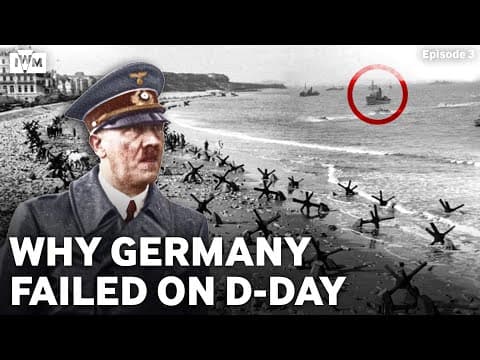
The reason Germany failed on D-Day (Imperial War Museums)
Imperial War Museums · 23:25